Independent Mold Testing. Air Sampling Solutions Explained.
1. Visual Inspection
After professional mold remediation has been completed, a visual inspection is performed inside the containment to verify that mold has been properly removed.
2. Moisture Testing
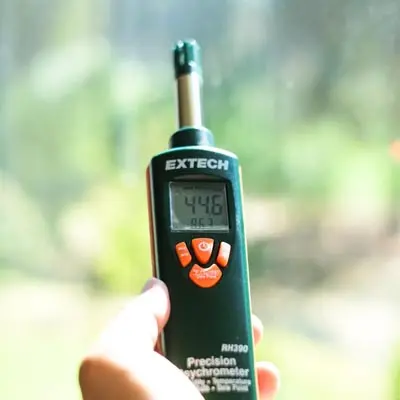
Moisture Testing is performed on building materials such as wood framing to ensure they are dry before closing up the walls and the flooring and before proceeding with repair or reconstruction.
3. Air Quality Testing
Air Sampling is an essential PRV or Clearance Inspection task in order to check whether the mold spore counts are at acceptable levels after completion of remediation work.
Science Based. Fungal Ecology.
Lab Verified Results — For Peace of Mind
To ensure that your property has returned to a Condition 1 status, professional lab testing can verify that your containments are clean.
What if You See or Suspect Mold?
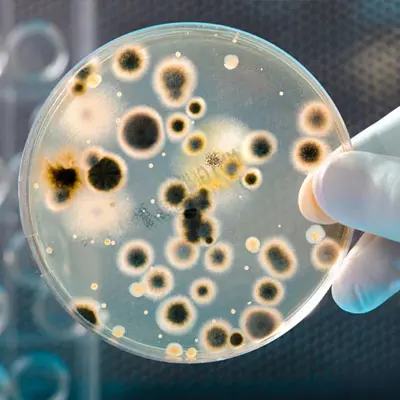
Surface samples may be taken by the Inspector for lab analysis if building materials appear to have remaining signs of mold.
During remediation, the containment area must be cleaned to remove all mold and debris. Wood framing that can be preserved must be wire brushed, wiped and HEPA vacuumed so that the surfaces are clean.
If there are stains, discoloration or residue that could point to mold growth — the inspector will need to take surface samples to send to the lab for analysis.
What if Lab Results Show Elevated Spore Counts?
A Mold Clearance may not be achieved if lab results point to a Condition 2 or Condition 3 status.
Thus, one criteria for successful clearance involves an air test result that reflects a Condition 1 status — A normal indoor condition where there is no evidence of mold growth or mold travel.
The desired Condition 1 indoor environment is not necessarily completely free of mold spores.
However, it should not have elevated spore counts. Thus, proper remediation involves implementing proper containment, Negative Air Pressure Machines, HEPA Air Filtration, wipe down of surfaces and HEPA vacuuming.
What If There Are High Moisture Readings?
Clearance may not be passed and additional dry out and dehumidification may be needed or the source of moisture may need to be resolved.
Drying building materials to proper levels is important before closing up the walls and the flooring and before proceeding with repair or reconstruction efforts — To ensure mold does not grow or return to the environment.
Samples are sent to an AIHA (American Industrial Hygiene Association) accredited laboratory that specializes in environmental microbiology.
ENVIRONMENTAL MICROBIOLOGY
Lab Reports
What Kind of Information is Contained in Lab Reports?
They provide very technical and detailed information that we analyze and summarize so that it is more friendly and useful to our customers.
The lab analysis will report on any mold found, the amount and the mold types detected (such as Aspergillus/Penicillium, Stachybotrys, Chaetomium, Ulocladium). We determine whether the sample indicates:
NORMAL FUNGAL ECOLOGY
An indoor environment that reflects a normal fungal ecology
SETTLED SPORES
An indoor environment that is contaminated with some settled spores
ACTUAL GROWTH
An indoor environment that is contaminated with actual mold growth and associated spores
FUNGAL DICTIONARY
What are common mold types found indoors?
Select a mold genus below to review its environmental characteristics and common indoor substrates.
Alternaria
Alternaria is one of the most common molds and is abundant worldwide. This genus contains around 40 to 50 different species, only a few of which are commonly found indoors. Alternaria spores are easily dispersed through the air by wind. Alternaria can grow on a variety of substrates indoors when moisture is present.
Cladosporium
Cladosporium is an abundant mold worldwide and is normally one of the most abundant spore types present in both indoor or outdoor air samples. This genus contains around 20 - 30 different species. Cladosporium produces dry spores that are formed in branching chains. Spores are released by twisting of the spore-bearing hyphae as they dry. Thus, the spores are most abundant in dry weather. Cladosporium can be found anywhere indoors, including textiles, bathroom tiles, wood, moist windowsills, and any wet areas in a home. Some species of Cladosporium grow at temperatures near or below 0(C) / 32(F) and can often be found on refrigerated foodstuffs and even frozen meat.
Penicillium / Aspergillus
Penicillium / Aspergillus are two separate genera of molds that are so visually similar that they are commonly discussed together as a group. Together, there are approximately 400 different species of Penicillium / Aspergillus. Penicillium / Aspergillus produce dry spore types that are easily dispersed through the air by wind. These fungi serve as a food source for mites, and therefore can be dispersed by mites and various insects as well. Penicillium / Aspergillus are found throughout the home. They are common in house dust, growing on wallpaper, wallpaper glue, decaying fabrics, wallboard, moist chipboards, and behind paint. They have also been isolated from blue rot in apples, dried foodstuffs, cheeses, fresh herbs, spices, dry cereals, nuts, onions, and oranges.
Chaetomium
Chaetomium is a common mold worldwide. This genus contains around 80 - 90 different species. Chaetomium spores are formed inside fruiting bodies. The spores are released by being forced out through a small opening in the fruiting body. The spores are then dispersed by wind, water drops, or insects. Chaetomium can grow in a variety of areas indoors, but is usually found on cellulosebased or woody materials in the home. It is very common on sheetrock paper that is or has been wet.
Stachybotrys
Stachybotrys is ubiquitous in nature. This genus contains about 15 species. Stachybotrys produces wet slimy spores and is commonly dispersed through water flow, droplets, or insect transport, less commonly through the air. Stachybotrys is common indoors on wet materials containing cellulose such as wallboard, jute, wicker, straw baskets, and other paper materials.
FAQ
Mold Frequently Asked Questions
Our Credentials
MICRO Certified Mold InspectorCMI # 86294
InterNACHI (International Association of Certified Home Inspectors) Certified Mold Inspector
Member # NACHI25081826 | Certificate # 1755634505
IAC2 Certified, IAC2 Mold Certified (International Association of Certified Indoor Air Consultants)
Certification ID: IAC2-95070
Friendly Communications. Lab Backed Data.
Our Process
Visual Inspections
We start with performing a visual inspection of the property, focusing on areas where there may be water damage, moisture issues or suspected mold growth.
Environment Readings
With the help of specialized tools we may take environmental readings such as Moisture Content (MC) or humidity levels in order to identify any potential issues.
Lab Testing & Analysis
Surface and Air samples may be recommended depending on the inspection findings or customer concerns. Such samples are sent to an AIHA Accredited Lab that specializes in identifying and analyzing mold.
Findings & Recommendations
Once all of the data is collected, we provide a report of our findings. If a mold growth problem is identified, a Remediation Protocol is outlined.