
Tanjun Mold Inspections logo

Professional Tools. Helpful Diagnostics.

Inspection & Test Technology

Learn about Thermal Imaging Cameras, Moisture Meters, Hygro-Thermometers, Air Quality Sampling Devices — And Their Abilities & Limitations


Call (818) 964-1533 Why We Combine Testing Methods
Scienced Based Testing In The Right Hands.

Human Skills Team Up with Advanced Tech

The trained human senses of an experienced inspector is undoudbtedly one of the most important assets. During the visual inspection, the inspector may be able to detect potential mold and moisture issues by using his eyes to examine various details, such as:

However, some things require more than our senses and our sight to detect or measure. This is where advanced, professional grade technology comes into play.

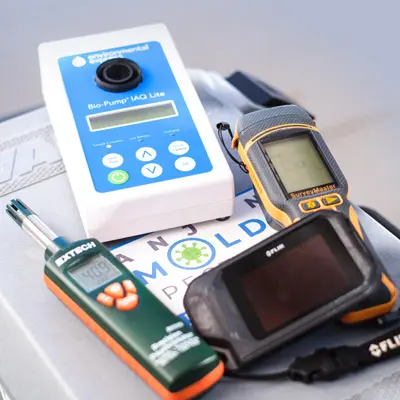
Overview panel of diagnostic equipment tools used by Tanjun Mold Inspections during professional mold inspections

Summary: An effective inspection begins with an inspector's trained eyes — checking for mold and signs of water damage. However, professional grade tools are vital for measuring environmental conditions like humidity and moisture. Further, specialized air pumps are instrumental for analyzing invisible mold spores.

Measure. Detect. Analyze Mold Risks.

Advanced Diagnostic Instrumentation

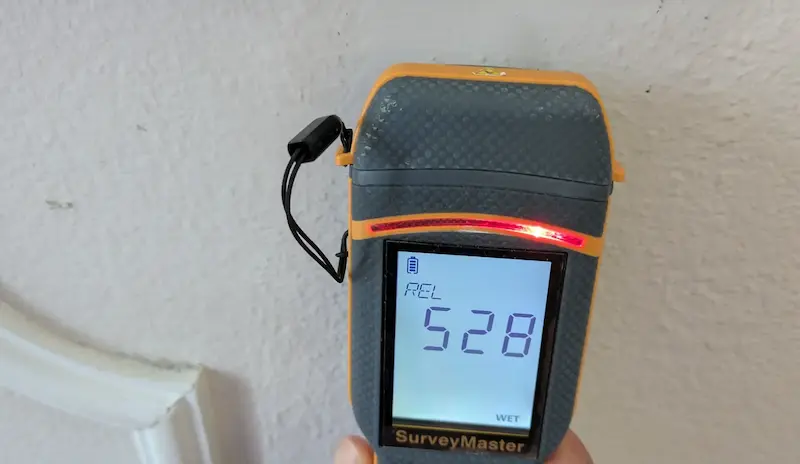
Moisture Meters Tanjun Mold Inspections using a digital Protimeter moisture meter to non-invasively measure moisture on the dryall.

Summary: Moisture testing is recommended promptly after a water damage or moisture intrusion event, such as from rains or plumbing leaks. If high Moisture Content (MC) is detected, there is a risk of mold growth and further evaluation is recommended.

Moisture Content (MC)

Moisture Meters are among the most critical tools since it helps inspectors measure moisture levels of various surfaces, including the walls and flooring. These readings can give us clues to where there may be moisture intrusion problems. And where there's moisture — the risk of mold growth exists.

At times the wall or floor surfaces may not yet show signs of water damage and may not feel moist to the touch. However, Moisture meters such as the Protimeter SurveyMaster can use Non Invasive (RF) technology to measure moisture beneath surfaces like wood, drywall or vinyl. It will emit electromagnetic signals to measure moisture levels at a nominal depth of up to 3/4" (19mm).

Additionally, the Pin-Type meter can be used which utilizes Electrical Resistance technology. Two sharp pins are pressed into the material and the device measures the resistance between them to determine precise moisture levels.

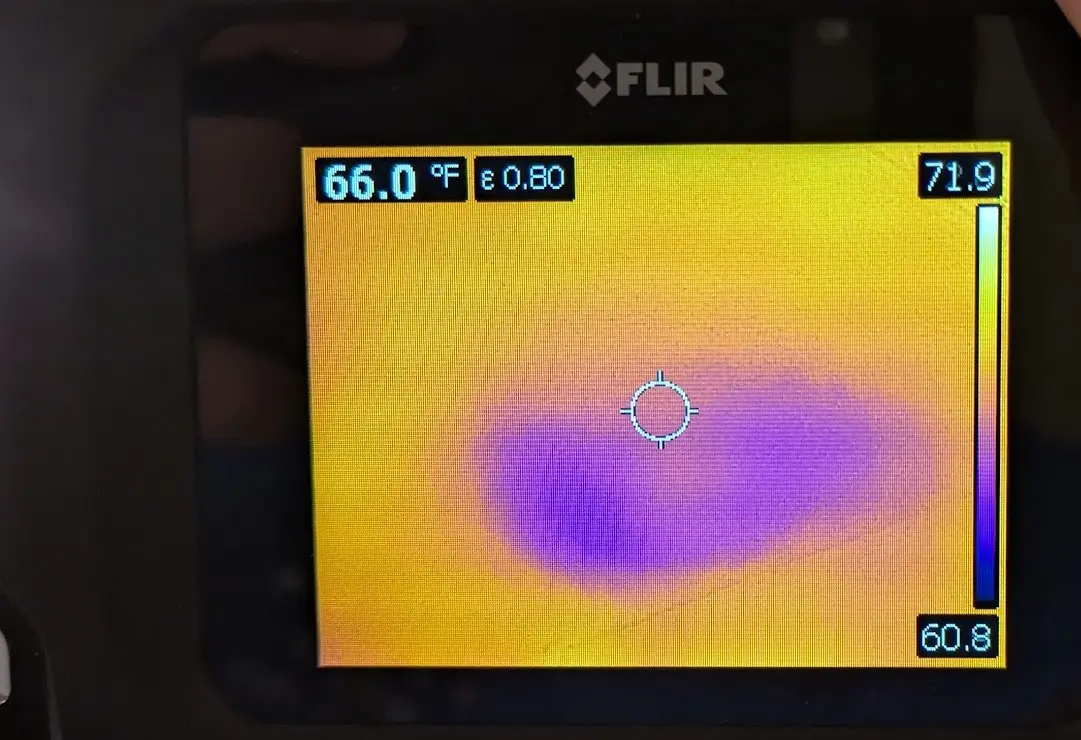
Thermal Imaging Tanjun Mold Inspections perfomring thermal imaging - Infrared screen showing blue and purple colors indicative of moisture cooling

Summary: Thermal cameras can display a temperature map of your rooms, potentially highlighting hidden cold spots where leaking water is evaporating. It cannot see through solid objects or detect mold directly — If there is a cool spot that is of concern, a Moisture Meter is used to check the building material.

Infrared Thermography

Thermal imaging cameras can assist inspectors to detect water intrusions. The infrared technology measures and maps out temperature differences, which may indicate areas where there is evaporative moisture cooling.

Evaporative Cooling: As moisture evaporates from building materials like drywall or wood, it cools the surface. On a thermal camera, these wet areas may appear as dark blue or purple "cold spots" compared to the warmer surrounding dry materials.

Condensation Points: Thermal readings may be able to reveal "thermal bridges"—areas with insufficient insulation where warm, moist indoor air meets a cold surface, creating the condensation that mold species such as Aspergillus and Penicillium may be able to thrive on.

Not a "Mold Camera": Because it only detects temperature, a thermal camera cannot distinguish between a clean water leak and a fully developed mold colony. Surface-Only Reading: It cannot see through materials like heavy insulation or thick stucco; it only reads the temperature of the surface it is pointed at. False Positives: Missing insulation, air drafts, or even reflective surfaces (like metal pipes) can look like moisture on a thermal screen.

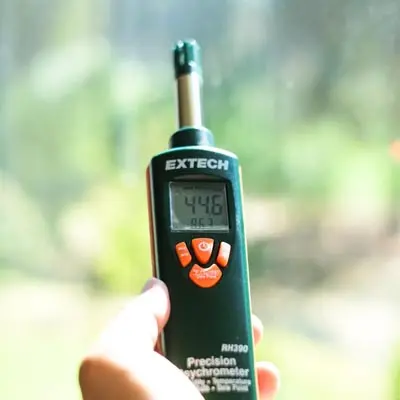
Hygro-Thermometers Tanjun Mold Inspections Inspector holding an Extech hygro-thermometer psychrometer to test relative humidity (RH)

Summary: Hygro-Thermometers can measure the Relative Humidity (RH) of the room at the same time as the temperature. With enough moisture in the air, some molds can grow on the various surfaces.

Relative Humidity (RH) & Temperature

Hygro-thermometers and Psychrometers allows us to measure both indoor and outdoor relative humidity and temperatures as well as dewpoint at the same time which can indicate areas susceptible to mold growth.

Checking indoor Relative Humidity is important since mold species differ in terms of what conditions they thrive in.

For example, some molds are hydrophilic and require significant water such as Ulocladium, Stachybotrys or Chaetomium.

Whereas xerophilic species such as some species of Aspergillus and Penicillium can grow with enough moisture in the air (high humidity) even if the surface itself never gets wet from a water leak.


Learn More About Mold Types
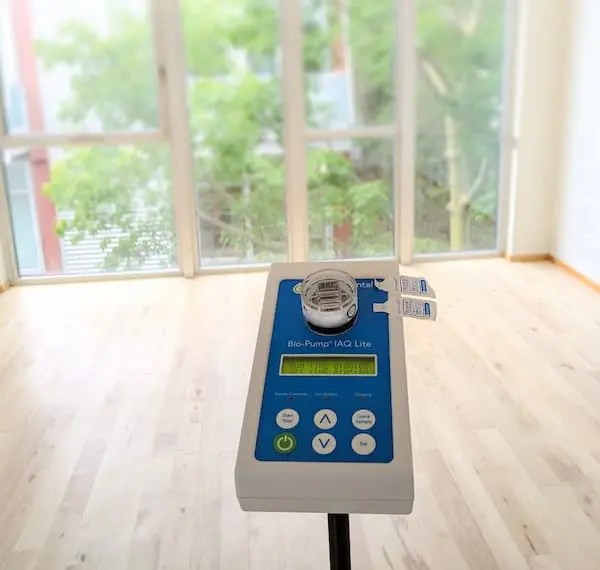
Air Sampling Tools Calibrated air sampling pump collecting spore trap particles near a window

Summary: Since you can't see floating spores with the naked eye, we use a specialized air pumps to trap particles on a cartridge with a sticky lab slide called spore traps. We then send those samples to a specialized laboratory to analyze the amount and types of mold spores detected.

Air Sampling Via Spore Traps

Air sampling tools allow us to get visibility into the microscopic realm by trapping mold spores that are not visible to the naked eye.

The lab results can help determine if there may be a mold growth risk indoors. We review (1) mold types and (2) spore counts against the outdoor control sample. Both ambient air and wall cavity sampling are options depending on the property condition and the customer's concerns and requests.

Speciality air cartridges are used to collect air particles and the samples are sent to an AIHA-accredited (American Industrial Hygiene Association) laboratory for analysis. The mold types and spore counts detected by the samples are included in the lab report.


Learn More About Air Sampling Call (818) 964-1533 Schedule Your Mold Test
The 3 Vital Methods To Assess Fungal Ecology

Why We Often Combine 3 Methods

Since each inspection method has limitations, relying on just one may miss important details.
Each method answers different mold and water damage questions — Combining all three contributes to a more thorough investigation — both before and after mold remediation.

Method 01

Visual Inspection

Purpose

Checks for visible mold growth, signs of water damage (like stains or bubbling), condensation, and moisture intrusion (such as by windows, sinks, and ceilings)

Limitations

Eyes cannot detect microscopic spores in your air — nor can it see inside walls or under floors. A room can look clean — but have elevated mold spore counts in the air. Surfaces can look dry — but retain high moisture.

See How We Solve This

Combine with Moisture Testing — to detect moisture behind walls or flooring and utilize Air Sampling — to measure invisible airborne spore levels in the breathing zone. Wall Cavity air sampling may be useful if hidden mold growth is suspected behind the walls.

Method 02

Moisture Testing

Purpose

Uses moisture meters to check for high moisture content (MC) such as in walls or flooring. Since mold needs moisture, checking for moisture is key.

Limitations

Moisture meters cannot detect (1) elevated mold spore counts in the air (2) remaining mold from past water damage or (3) if the moisture is trapped deeper into the wall cavity or building materials — even if there is mold growth.

See How We Solve This

Combine with a Visual Inspection — to check if there is visible mold on various building materials. If mold colonization inside walls or flooring causes spores to travel into the ambient air, Air Sampling may be able to detect it. Wall cavity air sampling may be able to detect mold growth behind the walls.

Method 03

Air Sampling

Purpose

Detects (1) mold types and (2) spore counts in the air — helpful for assessing fungal ecology for pre-remediation and essential for post-remediation clearance testing.

Limitations

Although elevated mold spores typically are found close to the growth source, air samples cannot identify the source of the leak. Mold spores may stay inside walls or flooring. Also, heavier and stickier spores may not become easily airborne.

See How We Solve This

Combine with Visual Inspections & Moisture Testing to check for areas at risk for mold growth or to trace elevated spore counts back to the source of the moisture intrusion.

Industry Standard: IICRC S520 Fungal Ecology

Can Visual Checks and Moisture Meters Alone Verify a Condition 1 Status?

No. Since mold spores are not visible when airborne, lab testing is required to assess fungal ecology. Under professional IICRC S520 guidelines, a home's fungal condition falls into three Conditions that eyes and moisture meters alone cannot verify:

Clearance - Post-Remediation Verification (PRV) Passing Clearance means the environment has returned to a Condition 1 status. Practically, this requires performing air sampling inside the containment in order to check the mold types and spore counts detected.
Pre-Remediation Inspections During an inspection where water damage has been experienced, or where there is risk of mold growth, a visual inspection should be combined with moisture content testing and where appropriate, air or surface sampling should be performed to assess the fungal ecology.
● Condition 1 — Normal Fungal Ecology An indoor environment that reflects a normal fungal ecology.
● Condition 2 — Settled Spores An indoor environment that is contaminated with some settled spores.
● Condition 3 — Actual Growth An indoor environment that is contaminated with actual mold growth and associated spores.
Your Friendly Test Only Inspector - Tanjun Mold Inspections

Suspect Mold?
Have Musty Odors or Symptoms?

Speak with our Certified, Test-Only Inspector.

Call Your Test-Only Inspector 818-964-1533

Our Credentials


MICRO Certified Mold Inspector CMI # 86294

InterNACHI (International Association of Certified Home Inspectors) Certified Mold Inspector

Member # NACHI25081826  |  Certificate # 1755634505

IAC2 Certified, IAC2 Mold Certified (International Association of Certified Indoor Air Consultants)

Certification ID: IAC2-95070

Friendly Communications. Lab Backed Data.

Our Process

Tanjun Mold Inspections performing- Professional Performing Visual Inspections

Visual Inspections

We start with performing a visual inspection of the property, focusing on areas where there may be water damage, moisture issues or suspected mold growth.

Tanjun Mold Inspections - Advanced Tools for Taking Environmental Measurements

Environment Readings

With the help of specialized tools we may take environmental readings such as Moisture Content (MC) or humidity levels in order to identify any potential issues.

Tanjun Mold Inspections - Lab Analysis for Mold Samples

Lab Testing & Analysis

Surface and Air samples may be recommended depending on the inspection findings or customer concerns. Such samples are sent to an AIHA Accredited Lab that specializes in identifying and analyzing mold.

Tanjun Mold Inspections Providing a Comprehensive Findings and Recommendations Report

Findings & Recommendations

Once all of the data is collected, we provide a report of our findings. If a mold growth problem is identified, a Remediation Protocol is outlined.

Dig Deeper • Educational Guides

Tanjun Knowledge Library

Plain-language guides on mold science, indoor air quality (IAQ), hidden moisture signs, and the test-only process.

Explore All Articles →

CONTACT US

Our Process - Advanced Tools for Taking Environmental Measurements

Book Your Test Only Inspection

Let Us Know Your Situation!

PHONE Call (818) 964-1533

EMAIL tanjunmold@gmail.com

SERVICE AREAS

Los Angeles County, CA

Ventura County, CA


TEST ONLY Test-Only Advantage

Contact Information

Property Address

Services Requested

Call (818) 964-1533 Schedule Inspection