Tanjun Mold Inspections logo

Learn More About Fungi

Mold Science & Research

Mold Research is Ongoing. Learn More About Mold, How it Grows in Buildings and its Effects on Humans, and — Air Sampling vs ERMI or HERTSMI-2 Testing.


Call (818) 964-1533
Fungal Ecology

What is Mold?

Molds are an abundant, naturally occurring life form belonging to the Fungi kingdom. Outdoors, they play a vital ecological role by breaking down dead organic matter—such as fallen leaves, wood, and plant debris — and safely recycling nutrients back into the soil.

However, active fungal growth should be avoided indoors. When molds grow on building materials, they have the potential to cause both progressive structural damage and effect health and indoor air quality. Common mold types frequently identified within residential and commercial buildings include Cladosporium, Penicillium, Aspergillus, Alternaria, Stachybotrys, Chaetomium, and Ulocladium.

Summary: Outdoors, mold is part of the natural clean up and recycling team. Indoors, however, it can prove damaging and harmful. Active mold growth in the walls, ceiling, flooring and other areas can damage the property and effect indoor air quality and health.

Microscopic visualization of mold colony growth pattern within laboratory environment
How Mold Grows In Building Materials

Environmental Triggers & Dynamics

Indoor mold growth generally require (1) moisture and (2) an organic food source in order to grow — for example, processed cellulose substrates like drywall paper, wood studs, hardwood flooring, or ceiling tiles. Mold spores are microscopic seedlike structures. Spores may spread from the outdoor air into the indoor environment and — given the right conditions, they can reproduce and grow within 24 to 72 hours of contacting a wet surface.

Hydrophilic Molds Black hydrophilic Stachybotrys chartarum mold colony growing on saturated drywall from water leak

"Water-Loving" / Tertiary Colonizers

Hydrophilic molds, often called "water-loving" or tertiary colonizers, are fungi that require high levels of moisture — water activity (aw) of 0.90 or higher —to grow. These molds are typically the last to appear during a water damage event because they need materials to be continuously wet or saturated rather than just damp.

High Water Requirement

These molds thrive on materials that have experienced leaks, floods, or chronic condensation. Examples include Stachybotrys and Chaetomium.

Aerosolization

Many hydrophilic molds have sticky spores that do not easily become airborne unless the material dries out or is physically disturbed.

In other words...

These molds require materials to be soaked or saturated, not just damp. Because their spores are heavy and sticky, they tend not to become airborne until they dry out or are disturbed physically.
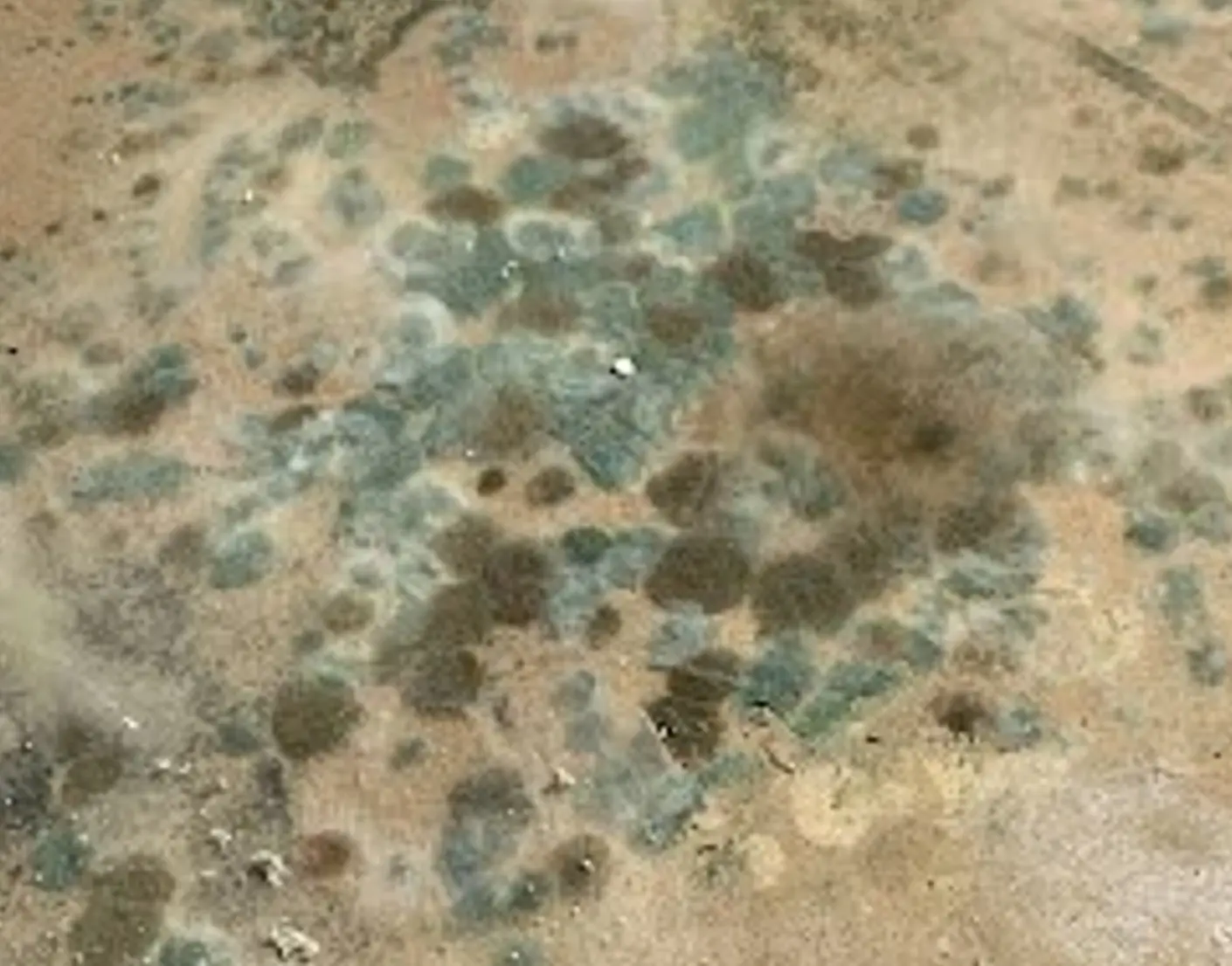
Xerophilic Molds Broad powdery layer of xerophilic Aspergillus and Penicillium mold growing on wood framing fueled purely by high indoor relative humidity

"Dry-Loving" / Primary Colonizers

Xerophilic molds (literally "dry-loving") are fungi that can grow in environments with little available water. While hydrophilic molds need a lot of water to grow, xerophilic molds can thrive on just high humidity. They are defined by their ability to grow at a water activity (aw) of 0.85 or below — and some extreme species can even survive down to 0.65.

Humidity Feeders

Xerophilic molds can pull enough moisture directly from the air if the relative humidity (RH) is consistently above 60-70%.

Primary Colonizers

They are often the first molds to appear when a room gets stuffy or damp, often paving the way for other molds later. Examples include Aspergillus and Penicillium.

In other words...

These molds don't need a plumbing leak to grow — they can feed purely off high humidity in the air. Rooms with inadequate ventillation or a moisture source can have high indoor humidity.

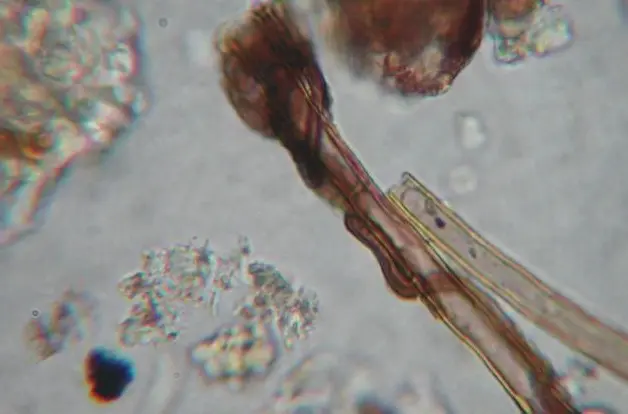
Hyphal Fragments Forensic laboratory microscope slide trace displaying a broken fungal hyphal root fragment captured from an indoor spore trap air sample

Microscopic Structural Indicators

As a comparison, hyphal fragments are basically the "broken-off branches" of a mold colony. If you think of mold as a plant, the spores are the "seeds," and the hyphae are the "roots and stems." When a colony is disturbed, dries out, or grows aggressively, these root-like structures can break apart into smaller pieces called fragments.

Indicator of Active Growth

Finding hyphal fragments on a lab report (especially an air sample) can point to a higher probablility of local mold colonization than finding spores alone. Spores can float in from an open window, but hyphal fragments are heavier and often don't travel as far.

Lab Report Analysis

If lab results detect hyphal fragments, that may indicate there is an active mold colony at the sampling location or nearby.

In other words...

Spores can easily blow into your house through an open window, but finding "hyphal fragments" means the lab found broken pieces of mold roots in your air. Their presence in air samples sometimes points to indoor mold growth problem.

Mold and Health Research

Can Mold Cause Health Problems?

Yes. indoor mold growth has the potential to cause health problems. Individuals differ in their response to mold. Also the amount of mold exposure may be a factor. Research on mold and its effect on human health is ongoing.

Disclaimer: The information provided on this page and this web site is for educational purposes only. Licensed medical professionals should be consulted for any health related questions or concerns. Always consult with qualified and licensed professionals before making structural repairs or health-related decisions. Moisture levels, mold species, and building conditions vary significantly; therefore, this data should not be used as a substitute for a professional mold inspection or formal lab analysis.

Centers for Disease Control (CDC)

"For some people, mold can cause a stuffy nose, sore throat, coughing or wheezing, burning eyes, or skin rash. People with asthma or who are allergic to mold may have severe reactions.

Immune-compromised people and people with chronic lung disease may get infections in their lungs from mold. For people who are sensitive to molds exposure to molds can lead to symptoms such as stuffy nose, wheezing, and red or itchy eyes, or skin.

Severe reactions, such as fever or shortness of breath, may occur among workers exposed to large amounts of molds in occupational settings, such as farmers working around moldy hay."

Environmental Protection Agency (EPA)

"Inhaling or touching mold or mold spores may cause allergic reactions in sensitive individuals. Allergic responses include hay fever-type symptoms, such as sneezing, runny nose, red eyes, and skin rash (dermatitis). Allergic reactions to mold are common. They can be immediate or delayed.

Molds can also cause asthma attacks in people with asthma who are allergic to mold.

In addition, mold exposure can irritate the eyes, skin, nose, throat, and lungs of both mold-allergic and non-allergic people."

Your Friendly Test Only Inspector - Tanjun Mold Inspections

Suspect Mold?
Have Musty Odors or Symptoms?

Speak with our Certified, Test-Only Inspector.

Call Your Test-Only Inspector 818-964-1533
Mold Data Analysis & Diagnostics

Professional Mold Testing Methods

Air Sampling — Indoor vs. Outdoor Control Baselines

Mold is naturally present in the outdoor air. When performing air sampling, an outdoor control sample is taken to establish a baseline. An indoor environment is often considered normal when the types and amounts of mold inside are below or similar to the outdoor sample. If a lab report shows elevated mold counts indoors — as compared to the outdoor sample — or detects certain types of molds that are absent outside, it can indicate a potential mold growth and moisture issues that may require further investigation.

In other words: We sample the outside air at the same time we test your inside air. The question is, "Are mold spores simply traveling from the outside into the indoor environment? Or, is there mold growth happening inside the building materials?"

Air Sampling vs. ERMI and HERTSMI

Property and homeowners researching advanced mold testing options often encounter the terms ERMI (Environmental Relative Moldiness Index) or HERTSMI-2 (Health Effects Roster of Type-Specific Formers of Mycotoxins and Inflammagens). Both rely on DNA-based testing to analyze mold species found in settled dust samples — an approach originally developed by the EPA as a research tool for ERMI.

However, the EPA and leading industrial hygiene and indoor air quality organizations — such as the AIHA — do not recommend ERMI testing for routine home inspections. Because mold DNA can persist indoors for years, an ERMI test may report historical mold signatures from an old leak that was resolved long ago. As a result, the test results can reflect past dust accumulation rather than what occupants are actively breathing.

It should be noted that some specialty medical practices do recommend ERMI and HERTSMI-2 to their patients. Physicians treating individuals with severe mold sensitivities or Chronic Inflammatory Response Syndrome (CIRS) sometimes request these tests to evaluate a home's overall fungal load against specific medical recovery thresholds.

For most home environments and general inspections, air sampling via spore traps remains the standard industry method. Spore traps collect a point-in-time sample of ambient air, which an accredited laboratory analyzes under a microscope. While a single air sample is only a brief snapshot of current conditions, combining those results with an outdoor control sample, a professional visual assessment, and moisture content (MC) testing — can provide a reliable picture of whether an active indoor mold issue is present.

Summary: An ERMI or HERTSMI-2 test can detect old mold DNA trapped in household dust — meaning it can report an elevated score from a problem resolved years ago. For most residential customers, pairing spore trap air analysis with a hands-on moisture and visual inspection is a more practical approach. It provides a real-time, room-specific assessment of your current environment—and wall cavity testing can be added if hidden moisture or mold is suspected behind a wall.

Test-Only

No Remediation. No Conflicts of Interest.

Since we do not perform mold removal or remediations, we avoid conflicts of interests. This allows us to focus on an objective, evidence based report and unbiased recommendations.

Call (818) 964-1533 Schedule Inspection
AIHA LAP Accredited Laboratory Logo Badge

Samples are sent to an AIHA (American Industrial Hygiene Association) accredited laboratory that specializes in environmental microbiology.

ENVIRONMENTAL MICROBIOLOGY


Lab Reports

What Kind of Information is Contained in Lab Reports?

They provide very technical and detailed information that we analyze and summarize so that it is more friendly and useful to our customers.

The lab analysis will report on any mold found, the amount and the mold types detected (such as Aspergillus/Penicillium, Stachybotrys, Chaetomium, Ulocladium). We determine whether the sample indicates:

  • NORMAL FUNGAL ECOLOGY An indoor environment that reflects a normal fungal ecology
  • SETTLED SPORES An indoor environment that is contaminated with some settled spores
  • ACTUAL GROWTH An indoor environment that is contaminated with actual mold growth and associated spores
FUNGAL DICTIONARY

What are common mold types found indoors?

Select a mold genus below to review its environmental characteristics and common indoor substrates.

Lab technician holding petri dish with mold growth analysis
Alternaria

Alternaria is one of the most common molds and is abundant worldwide. This genus contains around 40 to 50 different species, only a few of which are commonly found indoors. Alternaria spores are easily dispersed through the air by wind. Alternaria can grow on a variety of substrates indoors when moisture is present.

Cladosporium

Cladosporium is an abundant mold worldwide and is normally one of the most abundant spore types present in both indoor or outdoor air samples. This genus contains around 20 - 30 different species. Cladosporium produces dry spores that are formed in branching chains. Spores are released by twisting of the spore-bearing hyphae as they dry. Thus, the spores are most abundant in dry weather. Cladosporium can be found anywhere indoors, including textiles, bathroom tiles, wood, moist windowsills, and any wet areas in a home. Some species of Cladosporium grow at temperatures near or below 0(C) / 32(F) and can often be found on refrigerated foodstuffs and even frozen meat.

Penicillium / Aspergillus

Penicillium / Aspergillus are two separate genera of molds that are so visually similar that they are commonly discussed together as a group. Together, there are approximately 400 different species of Penicillium / Aspergillus. Penicillium / Aspergillus produce dry spore types that are easily dispersed through the air by wind. These fungi serve as a food source for mites, and therefore can be dispersed by mites and various insects as well. Penicillium / Aspergillus are found throughout the home. They are common in house dust, growing on wallpaper, wallpaper glue, decaying fabrics, wallboard, moist chipboards, and behind paint. They have also been isolated from blue rot in apples, dried foodstuffs, cheeses, fresh herbs, spices, dry cereals, nuts, onions, and oranges.

Chaetomium

Chaetomium is a common mold worldwide. This genus contains around 80 - 90 different species. Chaetomium spores are formed inside fruiting bodies. The spores are released by being forced out through a small opening in the fruiting body. The spores are then dispersed by wind, water drops, or insects. Chaetomium can grow in a variety of areas indoors, but is usually found on cellulosebased or woody materials in the home. It is very common on sheetrock paper that is or has been wet.

Stachybotrys

Stachybotrys is ubiquitous in nature. This genus contains about 15 species. Stachybotrys produces wet slimy spores and is commonly dispersed through water flow, droplets, or insect transport, less commonly through the air. Stachybotrys is common indoors on wet materials containing cellulose such as wallboard, jute, wicker, straw baskets, and other paper materials.

The 3 Vital Methods To Assess Fungal Ecology

Why We Often Combine 3 Methods

Since each inspection method has limitations, relying on just one may miss important details.
Each method answers different mold and water damage questions — Combining all three contributes to a more thorough investigation — both before and after mold remediation.

Method 01

Visual Inspection

Purpose

Checks for visible mold growth, signs of water damage (like stains or bubbling), condensation, and moisture intrusion (such as by windows, sinks, and ceilings)

Limitations

Eyes cannot detect microscopic spores in your air — nor can it see inside walls or under floors. A room can look clean — but have elevated mold spore counts in the air. Surfaces can look dry — but retain high moisture.

See How We Solve This

Combine with Moisture Testing — to detect moisture behind walls or flooring and utilize Air Sampling — to measure invisible airborne spore levels in the breathing zone. Wall Cavity air sampling may be useful if hidden mold growth is suspected behind the walls.

Method 02

Moisture Testing

Purpose

Uses moisture meters to check for high moisture content (MC) such as in walls or flooring. Since mold needs moisture, checking for moisture is key.

Limitations

Moisture meters cannot detect (1) elevated mold spore counts in the air (2) remaining mold from past water damage or (3) if the moisture is trapped deeper into the wall cavity or building materials — even if there is mold growth.

See How We Solve This

Combine with a Visual Inspection — to check if there is visible mold on various building materials. If mold colonization inside walls or flooring causes spores to travel into the ambient air, Air Sampling may be able to detect it. Wall cavity air sampling may be able to detect mold growth behind the walls.

Method 03

Air Sampling

Purpose

Detects (1) mold types and (2) spore counts in the air — helpful for assessing fungal ecology for pre-remediation and essential for post-remediation clearance testing.

Limitations

Although elevated mold spores typically are found close to the growth source, air samples cannot identify the source of the leak. Mold spores may stay inside walls or flooring. Also, heavier and stickier spores may not become easily airborne.

See How We Solve This

Combine with Visual Inspections & Moisture Testing to check for areas at risk for mold growth or to trace elevated spore counts back to the source of the moisture intrusion.

Industry Standard: IICRC S520 Fungal Ecology

Can Visual Checks and Moisture Meters Alone Verify a Condition 1 Status?

No. Since mold spores are not visible when airborne, lab testing is required to assess fungal ecology. Under professional IICRC S520 guidelines, a home's fungal condition falls into three Conditions that eyes and moisture meters alone cannot verify:

Clearance - Post-Remediation Verification (PRV) Passing Clearance means the environment has returned to a Condition 1 status. Practically, this requires performing air sampling inside the containment in order to check the mold types and spore counts detected.
Pre-Remediation Inspections During an inspection where water damage has been experienced, or where there is risk of mold growth, a visual inspection should be combined with moisture content testing and where appropriate, air or surface sampling should be performed to assess the fungal ecology.
● Condition 1 — Normal Fungal Ecology An indoor environment that reflects a normal fungal ecology.
● Condition 2 — Settled Spores An indoor environment that is contaminated with some settled spores.
● Condition 3 — Actual Growth An indoor environment that is contaminated with actual mold growth and associated spores.

Our Credentials


MICRO Certified Mold Inspector CMI # 86294

InterNACHI (International Association of Certified Home Inspectors) Certified Mold Inspector

Member # NACHI25081826  |  Certificate # 1755634505

IAC2 Certified, IAC2 Mold Certified (International Association of Certified Indoor Air Consultants)

Certification ID: IAC2-95070

Friendly Communications. Lab Backed Data.

Our Process

Tanjun Mold Inspections performing- Professional Performing Visual Inspections

Visual Inspections

We start with performing a visual inspection of the property, focusing on areas where there may be water damage, moisture issues or suspected mold growth.

Tanjun Mold Inspections - Advanced Tools for Taking Environmental Measurements

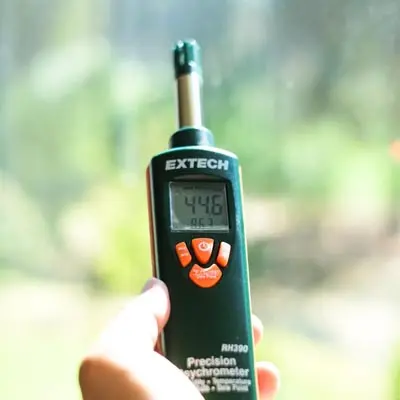
Environment Readings

With the help of specialized tools we may take environmental readings such as Moisture Content (MC) or humidity levels in order to identify any potential issues.

Tanjun Mold Inspections - Lab Analysis for Mold Samples

Lab Testing & Analysis

Surface and Air samples may be recommended depending on the inspection findings or customer concerns. Such samples are sent to an AIHA Accredited Lab that specializes in identifying and analyzing mold.

Tanjun Mold Inspections Providing a Comprehensive Findings and Recommendations Report

Findings & Recommendations

Once all of the data is collected, we provide a report of our findings. If a mold growth problem is identified, a Remediation Protocol is outlined.

CONTACT US

Our Process - Advanced Tools for Taking Environmental Measurements

Book Your Test Only Inspection

Let Us Know Your Situation!

PHONE Call (818) 964-1533

EMAIL tanjunmold@gmail.com

SERVICE AREAS

Los Angeles County, CA

Ventura County, CA


TEST ONLY Test-Only Advantage

Contact Information

Property Address

Services Requested

FAQ

Mold Frequently Asked Questions

Dig Deeper • Educational Guides

Tanjun Knowledge Library

Plain-language guides on mold science, indoor air quality (IAQ), hidden moisture signs, and the test-only process.

Explore All Articles →